
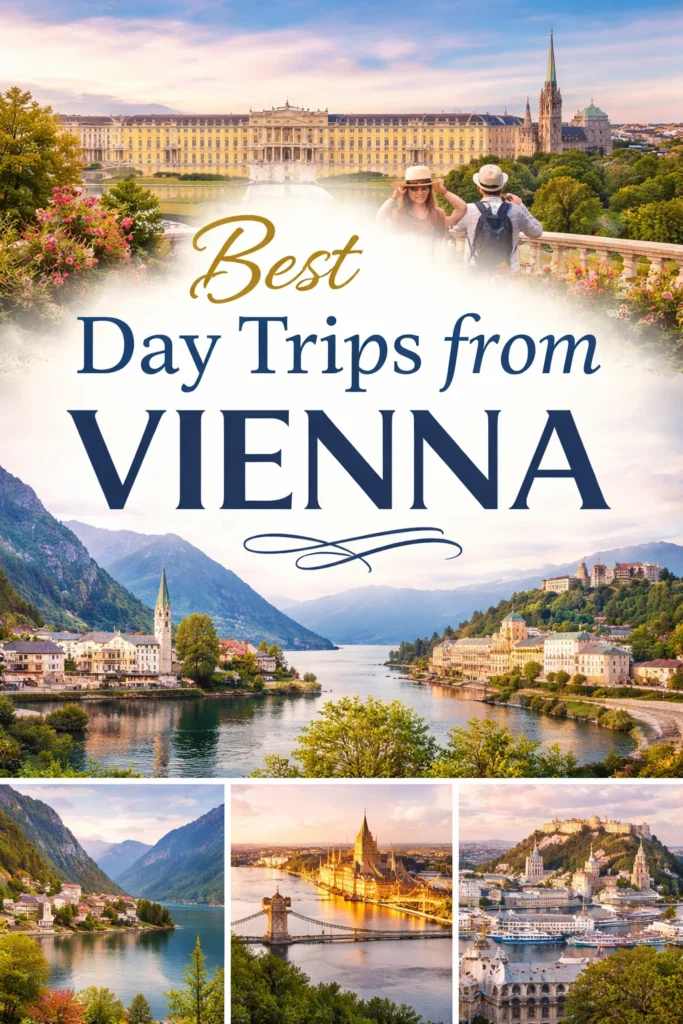
If you’re in Vienna and have one free day, don’t waste it wondering what to do. Some day trips from Vienna can take you to castles, charming towns, and even another capital city without needing a car.
In this article, we’re going to discover places where you can show up and enjoy yourself without turning the day into a logistics marathon.
7 Easy Day Trips From Vienna
This is the quick cheat sheet, and travel times are realistic door-to-door estimates.
| Day Trip | Travel Time | Best For | Top Highlights |
|---|---|---|---|
| Bratislava | About 1.5 to 2 hours | Quick international escape | Old Town, Castle, River views |
| Wachau Valley (Melk and Dürnstein) | About 1.5 to 2.5 hours | Scenic towns and culture | Melk Abbey, Dürnstein, Danube |
| Salzburg | About 3 to 3.5 hours | Classic Austria | Old Town, Mirabell Gardens, Fortress |
| Hallstatt | About 4 to 5 hours | Bucket list views | Lakefront, Viewpoints, Salt history |
| Budapest | About 3 to 3.5 hours | Big-city energy | Parliament, Thermal baths, Danube |
| Graz | About 2.5 to 3 hours | Relaxed culture | Old Town, Schlossberg, Cafés |
| Laxenburg Castle | About 45 to 75 minutes | Easy castle escape | Palace park, Boat ride, Gardens |
Bratislava Day Trip from Vienna
Bratislava is the easiest kind of international escape. You can wander a charming Old Town, head up to a castle viewpoint over the Danube, enjoy a long lunch, and still be back in Vienna later like it was a casual outing.
Bratislava was once the coronation city of the Kingdom of Hungary, which explains why it feels a bit royal in places, even though it’s small and relaxed.
The Old Town is compact in the best way. You can stroll without a plan, drift through little squares, stop for coffee when the mood hits, and never feel like you’re missing something important. Then comes Bratislava Castle, the main event. The view from up there is the kind that makes you pause for a second.
Afterwards, a riverside walk along the Danube is a nice way to slow down, and Bratislava has a playful side too. You’ll probably spot Čumil, the famous statue peeking out of a manhole, and the UFO-shaped tower on the SNP Bridge is one of those “only here” sights.
Half-day vs full-day itinerary
| Time | Half Day (4–6 hours) | Full Day (7–10 hours) |
|---|---|---|
| Late morning | Old Town wander + coffee | Old Town wander + slow café stop |
| Midday | Castle viewpoint | Castle viewpoint + time on the grounds |
| Lunch | Long lunch | Long lunch + dessert |
| Afternoon | Danube stroll | Danube stroll + UFO viewpoint + shopping |
| Wrap-up | Return to Vienna earlier | Return to Vienna later |
Wachau Valley Day Trip (Melk Abbey + Dürnstein)
This is the day trip you take when you want Vienna to feel far away, fast. The Wachau Valley is a Danube stretch between Melk and Krems that’s protected as a UNESCO cultural landscape, which is a fancy way of saying: the scenery and the history here are the real deal.
The vibe is calm and cinematic. River views. Hills rising behind little towns. And then, out of nowhere, Melk Abbey shows up like it’s trying to win an award for “most dramatic entrance.” It’s a huge Baroque complex perched above the river, and it’s been home to Benedictine monks in an uninterrupted tradition since the 11th century. That’s not a typo. Since 1089.
After Melk, Dürnstein feels like the charming “second act.” It’s smaller, prettier, and honestly hard not to like. And it comes with a proper legend: the ruins above town are tied to the story of Richard the Lionheart, who was held prisoner in the area after the Crusades. History with a little drama always hits different.
What you’ll actually experience
Melk Abbey feels grand and polished, with those big, sweeping interiors that make you instinctively lower your voice. The library is the kind of room that makes you think, “Okay, I get why people come here.”
Dürnstein, on the other hand, is all about the stroll. You wander along the river, weave through the town, and look up at the ruins like, “So… we’re really doing this medieval cliff-castle thing today.” Even if you don’t hike all the way up, the town itself has that storybook feel.
One easy full-day itinerary (Melk + Dürnstein)
| Time | Plan |
|---|---|
| Morning | Start in Melk Abbey while you’re fresh (it’s the day’s headline act) |
| Late morning | Take your time with the abbey interiors and viewpoints |
| Midday | Travel onward into the Wachau Valley and arrive in Dürnstein |
| Lunch | Lunch in town, then a slow riverside walk |
| Afternoon | Optional climb toward the Dürnstein ruins for the classic valley views |
| Late afternoon | Return to Vienna |
This is one of those Vienna day trips where you don’t need a packed schedule.
Salzburg Day Trip from Vienna
Salzburg is one of those places that already feels familiar before you even arrive. Maybe it’s the postcard views, maybe it’s the music history, or maybe it’s just the fact that it looks so perfectly put together. Either way, it delivers.
This is a day trip from Vienna that feels polished and iconic without being stiff. Salzburg has that rare mix of elegance and warmth. The historic center is beautiful, but it’s not the kind of place where you feel like you need to whisper the whole time. It’s lively, walkable, and just plain enjoyable.
A city built for great views
One thing that makes Salzburg stand out is the setting. You’re not only looking at baroque buildings and church domes. You’re also getting cliffs and mountains rising behind the city like a backdrop. It’s like the city was built with a “best angle” in mind.
Mozart’s hometown, without the theme-park feel
And yes, Mozart is everywhere. Salzburg is his birthplace, and you’ll see that legacy all over the city. But it doesn’t feel like a theme park. It feels more like a quiet confidence, like the city knows its cultural weight and doesn’t have to shout about it.
The Old Town is where the day naturally unfolds. Narrow streets, little courtyards, riverside views, and the kind of architecture that makes you slow down without noticing. Then you look up and see the star of the skyline: Hohensalzburg Fortress. It’s one of the largest fully preserved medieval fortresses in Europe, and it’s been perched above Salzburg since the 11th century. The views from up there are the kind that make people stop talking for a second.
Salzburg is totally worth it as a day trip, but it also has that effect where people leave thinking, “We could’ve stayed longer.” If there’s even a small chance you’ll turn it into an overnight, it helps to book a place that actually feels comfortable, not just “fine.” I use this quick hotel amenities checklist to spot the little details that make a stay feel upscale, quiet, and worth the money.
One easy full-day itinerary
| Time | Plan |
|---|---|
| Morning | Old Town wander, coffee, and the main historic streets |
| Late morning | Mirabell Gardens and classic city viewpoints |
| Midday | Hohensalzburg Fortress for the panoramic views |
| Lunch | Long lunch in Old Town or near the river |
| Afternoon | Riverside walk, shopping, and quiet side streets |
| Late afternoon | Return to Vienna |
Salzburg has that rare effect where the day feels full, but not exhausting. You come back to Vienna feeling like you’ve seen something iconic, and you still have energy left for the evening.
Hallstatt Day Trip from Vienna
Hallstatt is the kind of place that looks fake in photos. You know those “too perfect” lake pictures that seem edited? That’s Hallstatt. And yes, it really does look like that in real life.
This is one of those Vienna day trips that feels like stepping into a postcard for a few hours. A small village squeezed between a lake and steep mountains, with wooden balconies, sharp church spires, and the kind of calm that makes you automatically speak a little softer.
The story behind the scenery
Hallstatt is also one of the oldest salt mining areas in the world. Salt was the reason people settled here thousands of years ago, and it’s the reason the village became wealthy long before it became famous on Instagram. That salt history is so significant that it even gave its name to the “Hallstatt culture,” an early Iron Age civilization in Europe. That’s not travel trivia, that’s real historical weight.
What it feels like to spend the day here
The village itself is small, so the experience is less about ticking off attractions and more about soaking it in. The lakefront is where the magic is. You’ll see the classic viewpoint almost immediately, and then the fun becomes finding your own angles, wandering the quiet lanes, and stopping whenever you get that “wow” feeling again.
If you want the most dramatic views, Hallstatt doesn’t make you work too hard for them. The Skywalk viewpoint above the village delivers that wide “mountains and lake” panorama that people come for. It’s the kind of view that makes you pause, then check your camera roll, then pause again.
What’s also nice about Hallstatt is the pacing. Even when it’s busy, it’s still a village. There’s a natural limit to how much you can do, which means you’re forced to slow down and enjoy the atmosphere. And honestly, that’s the best way to experience it.
One easy full-day itinerary
| Time | Plan |
|---|---|
| Morning | Arrive and take a slow lakefront walk for the classic views |
| Late morning | Wander the village lanes and stop at the main viewpoints |
| Midday | Lunch with a lake view, no rushing |
| Afternoon | Skywalk viewpoint and, if you want, the Salt Mine experience |
| Late afternoon | Final stroll along the lake, then return to Vienna |
Hallstatt isn’t a place you “do” quickly. It’s a place you experience. A few hours here feels like a reset, like your brain finally took a deep breath.
Budapest Day Trip from Vienna
Budapest has a way of making an entrance. It’s bigger, bolder, and more dramatic than most Vienna day trips, and that’s exactly why it’s so exciting. The architecture is grand, the streets feel alive, and the Danube runs through the city like it’s showing off.
The thing Budapest does better than most cities
One of the most interesting things about Budapest is that it’s built on thermal springs. That’s why the bath culture here is such a big deal, and it’s not just for visitors. Locals actually go to the baths as part of everyday life, like it’s their version of a Sunday reset. Sitting in warm mineral water in a historic bathhouse while the city hums outside is peak Budapest. It’s relaxing, a little glamorous, and honestly one of the most memorable things you can do in one day.
Two sides, two moods
Budapest also has that satisfying “two cities in one” feel. On one side of the river is Buda, quieter and hillier, with viewpoints and castle scenery. On the other side is Pest, lively and energetic, packed with cafés, shopping streets, and those gorgeous buildings that make you look up every few minutes. Even in a day, you feel the difference, which keeps the trip from feeling repetitive.
And the iconic sights really do live up to the hype. The Hungarian Parliament building looks unreal on the riverfront, especially when the light hits it. Fisherman’s Bastion feels like a fairytale balcony over the city. The views alone are enough to justify the trip.
One easy full-day itinerary
| Time | Plan |
|---|---|
| Morning | Danube riverfront stroll and the Parliament area |
| Late morning | Buda-side viewpoints like Fisherman’s Bastion |
| Midday | Long lunch in a classic café setting |
| Afternoon | Thermal bath experience for the full Budapest vibe |
| Late afternoon | Final Danube walk and photos before heading back |
Budapest is the day trip that feels like a full-on experience. It’s lively, beautiful, and a little dramatic in the best way.
Graz Day Trip from Vienna
Graz feels like the cool, confident cousin who doesn’t need to brag. It’s Austria’s second-largest city, but it moves at an easier pace, with a creative, lived-in feel that’s different from Vienna’s grandeur and Salzburg’s polish.
One thing that makes Graz genuinely interesting is how old and young it feels at the same time. The historic center is a UNESCO World Heritage Site, filled with red rooftops, Renaissance courtyards, and narrow streets that reward wandering. At the same time, Graz has a big student population and a strong food scene, so the city feels alive, not frozen in time.
The heart of Graz is the Old Town, where you naturally drift from square to square without really trying. Then there’s Schlossberg, the hill rising right in the middle of the city. Locals treat it like their backyard. From the top, the view spreads out over the rooftops and river, and you finally understand why people rave about Graz’s skyline.
A small but memorable detail: the clock tower on Schlossberg is famous because its hands are reversed. The big hand shows the hours, and the small one shows the minutes. It’s a quirky leftover from an earlier time, and somehow very on brand for Graz.
What really sets Graz apart, though, is the atmosphere. Cafés feel local, markets feel real, and meals are taken seriously. It’s one of those places where lunch quietly turns into dessert and another coffee, and no one seems in a rush to leave.
One easy full-day itinerary
| Time | Plan |
|---|---|
| Morning | Wander the Old Town and its courtyards |
| Late morning | Head up to Schlossberg for city views and the clock tower |
| Midday | Long lunch in the center, followed by a relaxed stroll |
| Afternoon | Riverside walk, light shopping, cafés, and galleries |
| Late afternoon | Slow return to Vienna |
Graz is a great choice when you want something cultural but relaxed. It doesn’t overwhelm, it doesn’t rush you, and it leaves you with that quiet feeling of having discovered somewhere a little more personal.
Laxenburg Castle Day Trip from Vienna
Laxenburg is the kind of day trip that feels like pressing pause.
It’s close to Vienna, but once you’re there, the whole mood shifts. Instead of big-city sightseeing, it’s wide green parkland, quiet paths, and a palace setting that feels peaceful rather than crowded. It’s a classic “fresh air and pretty scenery” day, with a touch of royal history.
The reason Laxenburg feels special is that it was a favorite getaway of the Habsburgs. This wasn’t just a random palace. It was their countryside escape, where they went to slow down and breathe. And honestly, walking through the park today, you can see why. The grounds are huge and designed for wandering. It’s the kind of place where you stop checking your phone because you’re too busy enjoying the view.
The highlight for many people is the Franzensburg, a castle built like a romantic medieval fantasy. It sits on an island in the middle of the park, which already makes it feel a bit magical. It wasn’t built as a defense fortress.
Laxenburg also has one of those simple pleasures that makes the day feel luxurious: a boat ride on the lake. Nothing fancy, just a calm glide across the water with the castle in view. It’s the kind of moment that makes you think, “This is exactly what I needed.”
One easy full-day itinerary
| Time | Plan |
|---|---|
| Morning | Arrive and wander the park paths and gardens |
| Late morning | Visit the Franzensburg for the “storybook castle” moment |
| Midday | Lunch or café stop nearby, then a relaxed walk |
| Afternoon | Boat ride on the lake and more time in the park |
| Late afternoon | Return to Vienna feeling refreshed |
Laxenburg is perfect when you don’t want a big, busy day trip. It’s calm, elegant, and easy. The kind of place that makes you feel like you took a proper break, even if you were only gone for a few hours.
Best Time of Year for Day Trips from Vienna
These day trips work all year, so it really comes down to the vibe you want. Spring and fall are usually the easiest and most comfortable, with pleasant weather and a calmer feel. Summer gives you long days and bright scenery, but popular places can feel busier. Winter is colder, but it’s surprisingly charming for cities and indoor experiences, and Budapest’s thermal baths feel especially good when it’s chilly outside.
Key Takeaways: Pick the Perfect Vienna Day Trip
If you’re down to one free day and too many options, this makes it simple. Think of this as the “no regrets” cheat sheet. Pick what you want to feel, and the right day trip from Vienna becomes obvious.
| Travel Style | Best Day Trip from Vienna | Why It Works |
|---|---|---|
| Best overall | Wachau Valley (Melk + Dürnstein) | Balanced mix of scenery, history, and a relaxed pace |
| Best for luxury & comfort | Salzburg | Polished, iconic sights with an easy, refined feel |
| Best for adventure & views | Hallstatt | Dramatic lake and mountain scenery that feels special |
| Best for first-time visitors | Salzburg or Budapest | Salzburg is classic Austria, Budapest adds bold city energy |
| Best quick escape near Vienna | Laxenburg Castle | Close, peaceful, and perfect for a low-effort reset |
| Best for fewer crowds | Graz | Cultural, scenic, and noticeably calmer |
This is the easiest way to match your energy to the right day trip from Vienna. Pick the mood first, and the destination usually picks itself.
Frequently Asked Questions
What are the best day trips from Vienna without a car?
If you want the easiest “can’t-go-wrong” picks, it’s Wachau Valley, Salzburg, and Bratislava. They’re the best mix of iconic sights, smooth pacing, and a real change of scenery.
What are the easiest day trips from Vienna for first-time visitors?
Bratislava and Laxenburg. They’re close, simple, and you don’t need a complicated plan to have a great day.
Is Hallstatt a realistic day trip from Vienna in one day?
Yes, but it’s a long day. Hallstatt is worth it when the goal is the views and the atmosphere, not trying to squeeze in every single attraction.
Is Salzburg worth a day trip from Vienna, or should I stay overnight?
A day trip is totally worth it for the highlights. But Salzburg has a habit of making people wish they stayed longer. If you’ve got room for an overnight, it’s a nice upgrade.
Can I do a Budapest day trip from Vienna without feeling rushed?
Yes, as long as you keep it focused. Budapest is a big city, so it’s better to pick a few strong experiences and enjoy them properly than to race across town all day.
Bratislava vs Budapest: which is the better international day trip?
Bratislava is the quick, relaxed option. Budapest is the bold, dramatic “full capital city” experience. It really depends on whether you want easy and light or big and exciting.
What’s the best Vienna day trip for scenery and viewpoints?
For pure scenery, Hallstatt and the Wachau Valley are the winners. Salzburg is also surprisingly scenic once you see the city framed by mountains.
How do I avoid crowds on popular Vienna day trips?
Start earlier than you think, keep your plan simple, and avoid trying to see everything in one go. The trips feel a lot more enjoyable when the day has breathing room.